

Your child’s teacher says they had a good day. They managed lessons, followed instructions, played with friends and kept everything together.
Then they walk through the front door and seem to become a completely different child.
They might snap at a simple question, cry because the wrong cup is on the table, argue about taking their shoes off, collapse on the sofa or suddenly become loud, restless and impossible to reason with.
If you have ever wondered why your child falls apart after school, you are far from alone.
This pattern is often described as after-school restraint collapse: a child uses considerable emotional, social and cognitive effort to function through the school day, then releases some of that tension once they reach the place where they feel safest.
It is not a formal medical diagnosis, and not every difficult afternoon has the same cause. But the idea can be very useful because it changes the question from:
“Why are they behaving like this over something so small?”
to:
“What might their system have been carrying before they walked through the door?”
That shift can completely change how the first half hour at home feels.
Free After-School Regulation Checklist
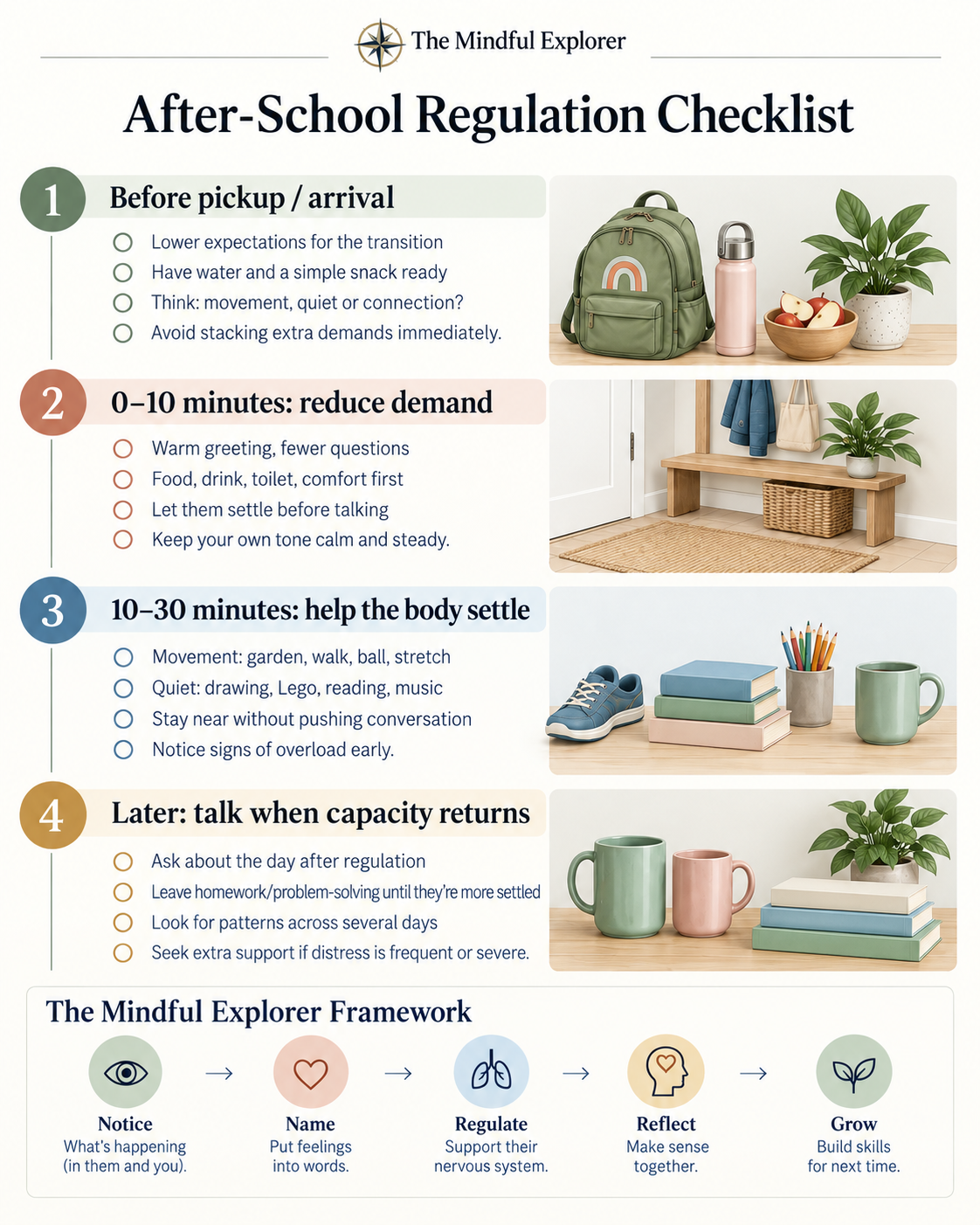
I created this free after-school regulation checklist as a simple visual guide for the first 30 minutes after school.
It is designed to help parents reduce unnecessary demands, meet basic body needs, create space for decompression and delay bigger conversations until a child has more capacity.

Download the Free After-School Regulation Checklist
Why does my child fall apart after school?
A school day asks a great deal from a child.
They may be managing noise, transitions, instructions, academic work, friendship dynamics, waiting, sitting still, sharing attention, remembering equipment, reading social cues and controlling impulses for several hours at a time.
Some children appear to manage all of this extremely well at school. That does not necessarily mean it costs them nothing.
By the time they get home, their regulatory resources may simply be low.
In Why Does My Child Fall Apart After School?, I explore this pattern in more depth. One useful idea is that the behaviour you see at 4pm may be the final expression of pressure that began much earlier in the day.
Signs of after-school restraint collapse
After-school restraint collapse does not look identical in every child.
Some children become obviously emotional. Others become oppositional, silly, hyperactive or unusually withdrawn.
Common signs can include:
- irritability immediately after school;
- crying over apparently small problems;
- arguing about normal routines;
- refusing homework or simple requests;
- becoming loud, restless or physically active;
- withdrawing and not wanting to talk;
- appearing exhausted;
- increased sibling conflict;
- strong reactions to hunger, noise or disappointment;
- seeming unable to answer ordinary questions about the day.
None of these signs proves that restraint collapse is the cause. Hunger, tiredness, neurodivergence, school anxiety, sensory overload, friendship problems, bullying, academic pressure and many other factors can contribute.
The value of the regulation approach is that it encourages us to look at capacity before compliance.
The first 30 minutes after school
The biggest mistake many well-intentioned parents make is moving their child immediately from one demanding environment into another.
The sequence can look something like this:
“How was school? What did you do? Have you got homework? Put your shoes away. Wash your hands. Get changed. We need to leave for swimming in twenty minutes.”
None of those requests is unreasonable.
But together they can land on a child whose system has already spent hours working hard.
The checklist therefore breaks the transition into four stages.
1. Before pickup: reduce the load
A calmer after-school transition often starts before your child arrives home.
Think about the practical things that commonly create friction. Hunger is an obvious one. So are rushing, multiple instructions and immediately needing to leave again.
Where possible, prepare a simple snack and drink and consider whether the afternoon can contain a short period with fewer demands.
2. The first 10 minutes: ask less
Many parents naturally want to reconnect by asking about school.
But a child who has spent all day responding to questions and instructions may not yet be ready to tell the story of their day.
A warm greeting can be enough.
You might say:
“Good to see you. Take a little time to settle.”
Food, drink, the toilet, physical comfort and simple proximity may matter more than conversation at this point.
3. Ten to thirty minutes: help the body settle
Different children regulate in different ways.
One child may need to run around the garden, kick a ball or walk the dog. Another may need drawing, Lego, reading, music or simply being close to a parent without having to talk.
The question is not “What is the perfect calming activity?”
It is:
“What usually helps this particular child move from school mode back into themselves?”
If your child regularly struggles with emotional regulation, you may also find Nervous System Regulation for Kids useful.
4. Talk when capacity has returned
Reflection, homework and problem-solving tend to work better when a child is no longer at the peak of dysregulation.
This does not mean difficult behaviour is ignored.
It means we distinguish between the moment for regulation and the moment for reflection.
The Mindful Explorer Framework and after-school regulation
The checklist uses the same sequence that sits underneath The Mindful Explorer Framework:
Notice → Name → Regulate → Reflect → Grow.
During a difficult after-school moment, parents often jump straight to Reflect:
“Why did you do that?”
“You know that isn’t okay.”
“What should you have done instead?”
Those conversations matter, but they are often more useful after the nervous system has settled.
The framework starts earlier.
Notice: What is happening in my child and in me?
Name: What might this feeling or state be?
Regulate: What helps the body regain enough capacity?
Reflect: What happened and what can we understand from it?
Grow: What skill can we build for next time?
When after-school meltdowns happen every day
If your child is experiencing severe or frequent distress after school, it is worth looking beyond the transition routine itself.
Patterns may reveal useful information.
Do difficult afternoons happen after particular lessons? On days with PE? After playground difficulties? Following noisy assemblies? At the end of especially structured days?
Keep brief notes for a week or two rather than relying on memory.
If you are concerned, speak with your child’s teacher, SENCO, GP or another appropriate professional. Essex SEND guidance similarly recommends looking at what happens across the school day rather than focusing only on the behaviour seen at home.
Helping children build regulation rather than simply demanding calm
The longer-term goal is not to create a child who never becomes overwhelmed.
Emotional regulation develops gradually.
Children learn to notice signals in their body, recognise emotion, tolerate discomfort, recover from stress and eventually choose useful responses with increasing independence.
The Emotionally Strong Child explores this developmental process in much greater depth, including why the primary-school years matter so much for confidence, resilience and emotional self-understanding.
The after-school checklist is simply one practical place to begin.
Frequently asked questions about after-school restraint collapse
Is after-school restraint collapse real?
The phrase is widely used to describe children who hold themselves together through school and release stress after returning home. It is a descriptive term rather than a formal diagnosis, and parents should consider other possible causes where distress is significant.
Why is my child good at school but badly behaved at home?
Home may be the place where a child feels safe enough to release the effort they have used all day. Hunger, tiredness, sensory overload, social stress and difficulty with transitions can also contribute.
Should I let my child avoid homework after school?
Not necessarily. The useful question is often timing. A short regulation window before homework can make later cooperation easier without removing the expectation altogether.
How long should after-school decompression last?
There is no universal number. The checklist uses roughly 30 minutes as a practical starting point, but some children will need less and others more.
What if my child does not want to talk about school?
Avoid forcing conversation immediately. Many children talk more freely once they have eaten, moved, rested or reconnected through a low-pressure activity.
Download the checklist
You are welcome to download, save and print the After-School Regulation Checklist for personal use.
This article provides general educational information. Persistent, severe or unsafe behaviour may require support from school, healthcare or other appropriate professionals.