

Family stress does not always look like shouting.
Sometimes everybody is functioning.
Children are going to school. Dinner is being made. Work is getting done. Nobody is having dramatic arguments.
And yet the atmosphere at home has changed.
Patience is shorter. People notice the phone more. A child starts asking whether you are okay. Small problems feel bigger. Adults are physically present but mentally elsewhere.
If this sounds familiar, the important question may not simply be:
“Are we stressed?”
but:
“Is this stress passing through our family — or is it beginning to organise the way home feels?”
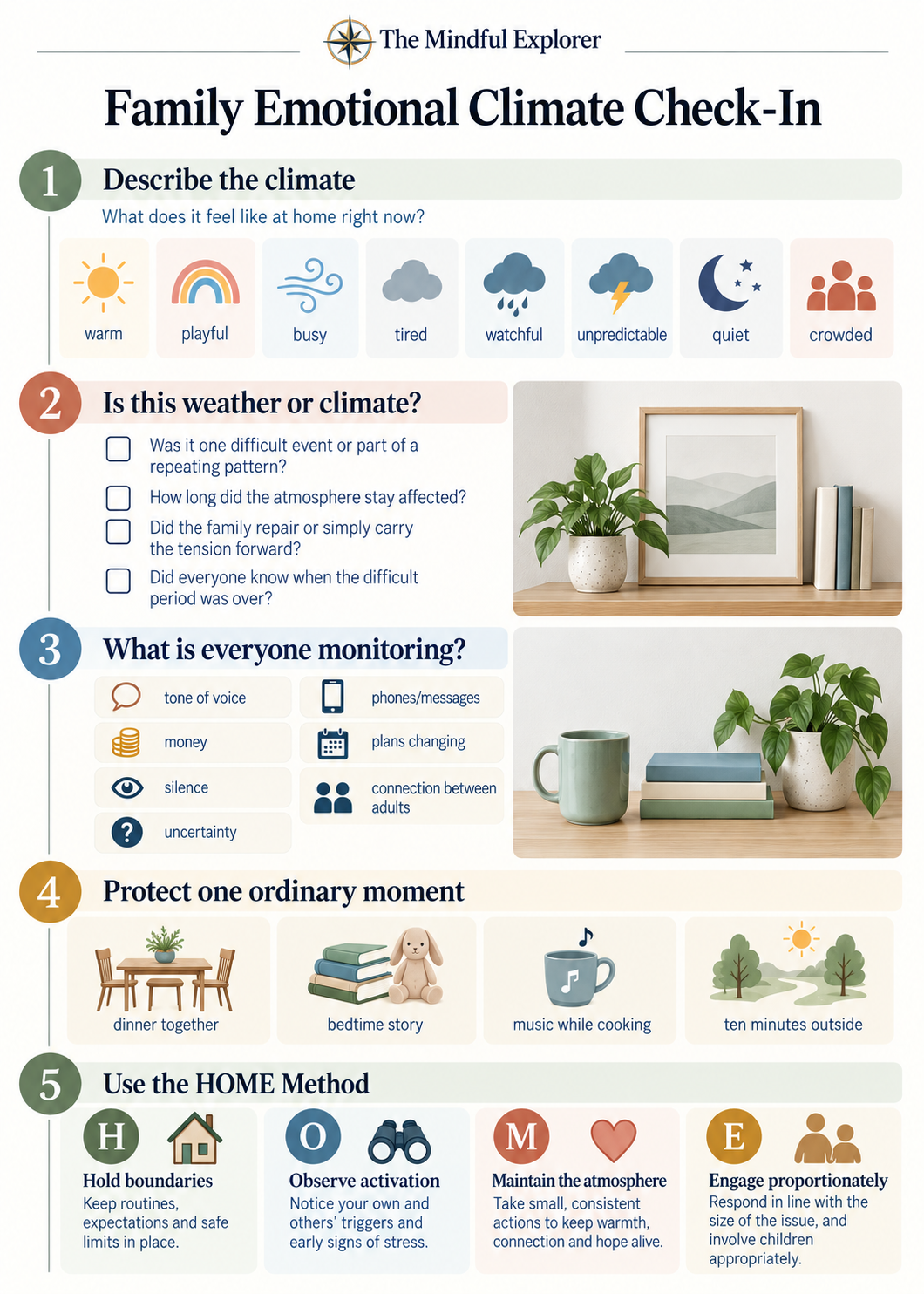
This free Family Emotional Climate Check-In is designed to help you answer that question without turning normal family strain into another thing to worry about.
Download the free Family Emotional Climate Check-In

Download the Free Family Emotional Climate Check-In
How does family stress affect children?
Children do not need to know the details of an adult problem to experience its emotional effects.
They notice changes in attention, tone, routines and availability.
They may notice that a parent checks their phone repeatedly. They may sense that two adults are quieter with one another. They may notice that familiar routines disappear or that small mistakes suddenly produce bigger reactions.
This does not mean children are damaged by seeing adults stressed.
Stress is part of life.
The more useful distinction is between an emotional event and an emotional climate.
Government research has long linked stressful family circumstances with differences in children’s emotional, social and educational outcomes, while more recent mental-health guidance also emphasises the importance of consistent parenting, clear information and whole-family support.
Emotional weather versus emotional climate
Every family has emotional weather.
A difficult phone call. A deadline. A financial problem. Illness. A disagreement. A tired parent. A child having a meltdown.
None of those things automatically means the emotional environment is unhealthy.
An emotional climate is different.
It is the pattern that forms when people begin expecting the tension to continue.
Ask:
- How long does the atmosphere stay changed after a difficult moment?
- Do family members keep monitoring one another?
- Does everybody know when the stressful period is over?
- Does the same outside problem keep entering unrelated family moments?
- Are normal routines disappearing?
- Does relaxing feel inappropriate because the problem is still unresolved?
You can explore this distinction further in How Family Stress Affects Children.
Signs family stress may be changing the atmosphere at home
Children begin monitoring adults
A child repeatedly asks “Are you okay?”, watches your face after a notification or changes their behaviour according to your mood.
This may be an attempt to create predictability.
Small problems produce unusually large reactions
When adults are already carrying pressure, there is less spare capacity for spills, forgotten shoes, sibling arguments and ordinary family friction.
Attention is constantly pulled somewhere else
You may be sitting at the table while mentally replaying an argument, waiting for an email, worrying about money or thinking about work.
Ordinary routines disappear
Bedtime stories become rushed. Meals happen separately. Nobody walks the dog together. Music stops playing while dinner is made.
These moments may look insignificant next to the problem, but they provide continuity.
Why routines matter during periods of family stress
Routine does not remove stress.
It gives the family something predictable alongside it.
That might mean maintaining one bedtime routine, eating together several times a week, taking a short walk or protecting ten minutes where nobody discusses the unresolved problem.
The aim is not forced positivity.
It is to stop one stressor from becoming the only emotional reality available to the family.
What is everybody monitoring?
One of the most useful sections of the free worksheet asks what family members have become unusually alert to.
This can include:
- tone of voice;
- phones and messages;
- money;
- plans changing;
- silence;
- the relationship between adults;
- uncertainty about what will happen next.
Monitoring often grows when important things feel unclear.
That is why calm, age-appropriate clarity can be protective.
A parent might say:
“I’m worried about an adult issue. You are safe, and you do not need to solve it.”
The child receives useful information without receiving the adult burden.
The HOME Method
The worksheet also introduces the HOME Method from The Present Home.
H — Hold boundaries
Ask what needs a clear limit so that the stressor does not have unlimited access to your home, relationships or children.
O — Observe activation
Notice when the room is becoming tense and what is happening in your own body.
M — Maintain the atmosphere
Protect enough ordinary family life that home does not have to wait for every problem to be resolved before it can feel like home again.
E — Engage proportionately
Ask what actually requires action now.
If nothing can be done tonight, give the problem a return point:
“We’ll look at this again when the report arrives.”
That is different from ignoring the issue.
It places the issue in time instead of allowing it to occupy every available moment.
How parental stress can affect children
Parental stress and parental mental-health difficulties do not automatically produce poor outcomes for children.
Many families navigate substantial pressure while remaining loving, supportive and secure.
But children can be affected when adults do not have enough support or when they begin taking on emotional responsibility that does not belong to them.
The Mental Health Foundation identifies protective factors including consistent parenting, support from other trusted adults, clear age-appropriate information and whole-family support.
Protect one ordinary moment
The Family Emotional Climate Check-In includes one deliberately simple action:
protect one ordinary family moment.
That might be:
- dinner together;
- a bedtime story;
- music while cooking;
- ten minutes outside;
- a cup of tea together;
- one conversation where the unresolved problem is not discussed.
You do not need to transform the whole household.
Continuity is built through repetition.
When family stress needs more than a worksheet
Some stressors require practical protection and professional support.
Abuse, coercive control, immediate danger, significant mental-health concerns, serious financial or legal risk and safeguarding issues should not be treated simply as emotional-regulation problems.
Use appropriate medical, psychological, safeguarding or legal support when needed.
Frequently asked questions about family stress
Can children sense stress between parents?
Yes. Children often notice tone, attention, routine changes, silence and emotional availability even when they do not understand the adult details.
Does arguing in front of children always harm them?
Not every disagreement is harmful. Frequency, intensity, resolution and whether the child becomes caught in the conflict all matter.
How can I protect my child when I am stressed?
Acknowledge what is appropriate, reassure them that adult problems are not theirs to solve, maintain basic routines and repair moments where stress has spilled over.
What is an emotional climate?
It is the repeated emotional atmosphere people come to expect at home rather than one isolated difficult event.
Download the free check-in
Save, print or use the Family Emotional Climate Check-In whenever family stress has been running for longer than you expected.Download the free resource
For a deeper exploration of how outside stress becomes part of family life, visit The Present Home or explore Research & Further Reading.