

A difficult co-parenting message rarely contains just one thing.
There may be a genuine question about your child buried underneath criticism. A request about a pickup time may arrive alongside an accusation. A simple arrangement can suddenly include old relationship history, assumptions about your motives and pressure to answer immediately.
That is why co-parenting communication can become exhausting even when the practical issue itself is relatively small.
The challenge is often not knowing what to say.
It is deciding:
What actually needs a response here?
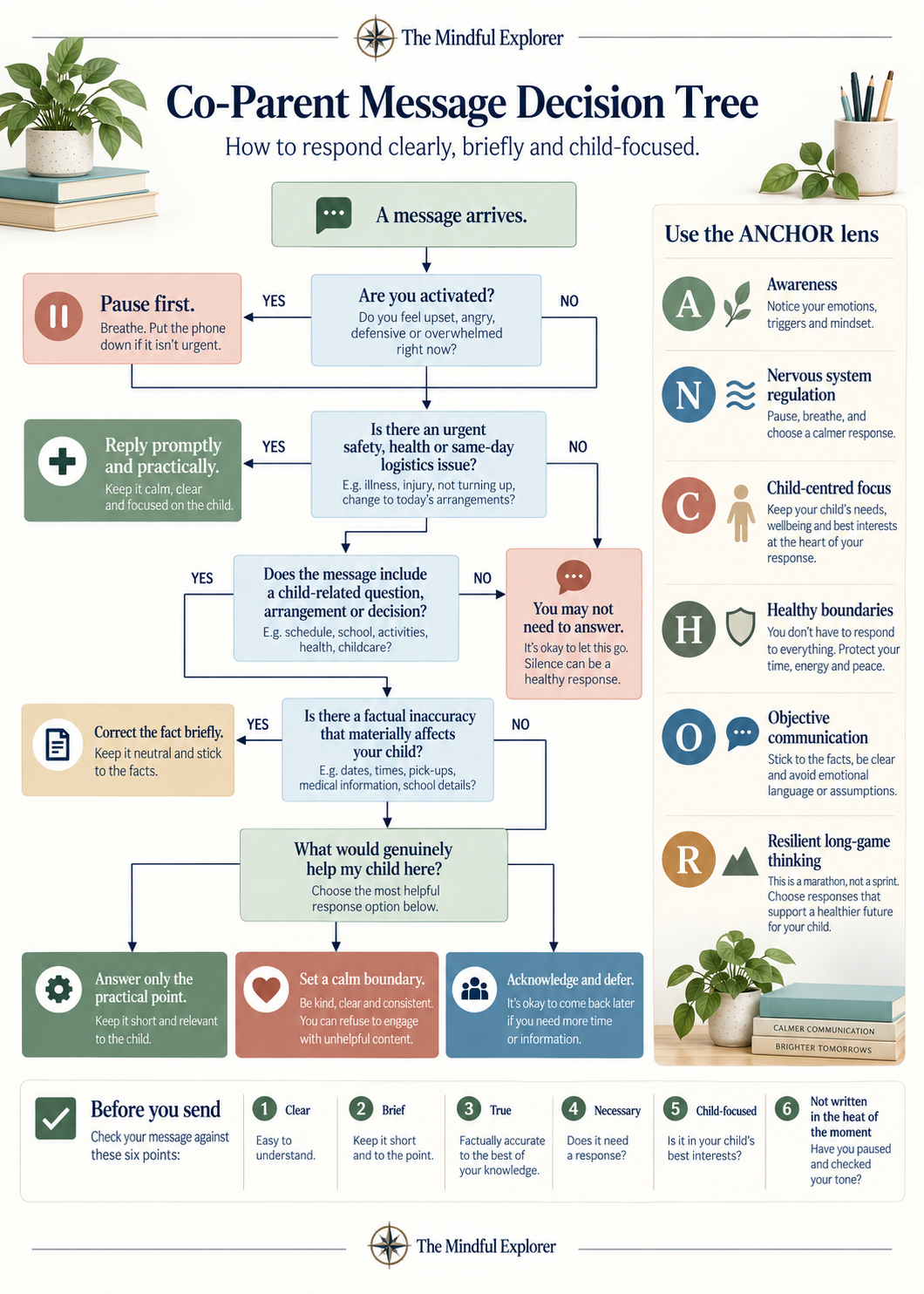
This free Co-Parent Message Decision Tree is designed to help separated parents slow that process down and identify the smallest useful, child-focused response.
Download the free Co-Parent Message Decision Tree

Download the Free Co-Parent Message Decision Tree
Why co-parenting messages escalate so easily
Text and email remove much of the context we use in ordinary conversation.
Tone is inferred. Delays are interpreted. Short messages can feel dismissive. Long messages can feel overwhelming.
After separation, existing hurt or mistrust can make this even harder.
Cafcass advises separated parents to keep their own feelings about one another separate from the co-parenting task wherever possible, keep communication focused on the child and avoid using the child to pass messages between adults.
That sounds straightforward.
In practice, it can be extremely difficult when the message you receive feels unfair, provocative or controlling.
The biggest communication trap: answering everything
Imagine receiving this:
“You’re late again. You clearly don’t respect my time. Can you bring her school bag at 5pm instead of 5.30? And you still haven’t explained why you changed things last weekend.”
There are several different things in that message.
But only one or two may require an actual response.
The practical issue might simply be:
“Yes, I can bring the school bag at 5pm.”
Replying to every accusation creates more material for the next message.
This is particularly relevant in high-conflict co-parenting, where conversations repeatedly expand beyond the child-related decision that started them.
Step 1: Are you activated?
Your first decision may not be about wording at all.
It may be whether you should reply right now.
Notice the physical response.
Are you angry? Shaky? Defensive? Rehearsing an argument in your head? Writing paragraphs before you have even decided what the actual question is?
If the issue is not urgent, a pause can create enough space to move from reaction to choice.
This is not about punishing the other parent with silence.
It is about not allowing a notification to decide your nervous system’s timetable.
Step 2: Is there an urgent safety, health or same-day issue?
Urgent child-related matters come first.
Examples might include:
- illness or injury;
- a child not arriving where expected;
- a same-day change that genuinely requires a decision;
- important medication information;
- a safeguarding issue.
Respond to the practical issue promptly and clearly.
If there are threats, domestic abuse, stalking, coercive control or serious safeguarding concerns, ordinary communication techniques are not enough. Use appropriate specialist and legal support.
Step 3: Does the message contain a child-related question?
Strip away tone and commentary.
What remains?
Is there a question about:
- school;
- health;
- clubs or activities;
- childcare;
- pickup or handover;
- a schedule change;
- equipment or belongings;
- a decision affecting the child?
If yes, answer that issue.
If no action is actually required, a response may not be necessary simply because a message was sent.
Step 4: Is there a factual inaccuracy that materially matters?
This is one of the hardest distinctions.
An inaccurate statement can create a powerful urge to correct the record.
Sometimes that is necessary.
If the fact materially affects your child’s medical information, school, arrangements, pickup time, legal decision or safety, correct it briefly.
But if an unfair statement changes nothing practical, answering it may simply extend the argument.
Not responding to every accusation is not the same as agreeing with it.
Step 5: What would genuinely help the child?
This is the central filter.
The useful response may be:
Answer the practical point
“That works. I’ll collect at 5pm.”
Set a calm boundary
“I’m not discussing this at handover. I’ll reply later in writing.”
Acknowledge and defer
“I’ve seen this. I need to check the details and I’ll confirm tomorrow.”
These responses are not legal formulas.
The principle is proportionality.
The ANCHOR Framework for difficult co-parenting communication
The decision tree also uses the ANCHOR Framework from Becoming the Anchor Parent.
A — Awareness
Notice your triggers and the patterns that make you most likely to react.
N — Nervous System Regulation
Give yourself enough internal space to choose the response rather than simply discharge the emotion.
C — Child-Centred Focus
Ask which part of the interaction actually matters to your child.
H — Healthy Boundaries
Decide what you will and will not engage with.
O — Objective Communication
Keep useful communication factual, specific and proportionate.
R — Resilient Long-Game Thinking
Judge your parenting by the pattern you are building over months and years rather than whether you corrected every unfair statement today.
Before you send a co-parent message
Use six quick checks:
- Clear: Is it easy to understand?
- Brief: Is there anything unnecessary?
- True: Is it factual rather than based on assumptions?
- Necessary: Does this actually need to be said?
- Child-focused: Is this relevant to the child?
- Regulated: Have I paused long enough to check my tone?
What does good co-parenting communication look like?
Good communication does not necessarily mean friendly conversation.
In some separated families, success may simply mean reliable functional communication about the child.
UK government research with separated parents has documented exactly this distinction: some parents reported being able to manage essential child-related communication even while the wider relationship remained very difficult.
That can be enough to build structure.
Should co-parents communicate by text or email?
There is no single best channel for every family.
The useful goal is usually to reduce confusion and unnecessary crossover.
Some parents choose email, text or a dedicated co-parenting app.
Where conflict is high, having one primary written channel can help keep practical arrangements separate from other areas of life.
Do I have to respond to every co-parent message?
No general rule says every comment requires a reply.
You should respond to important child-related information, genuine requests, agreed responsibilities and matters you are legally required to address.
But criticism, provocation and commentary do not automatically become actionable simply because they arrive in a message.
How to communicate with a difficult ex about children
When communication is repeatedly difficult, simplify.
Use dates, times, specific requests and clear answers.
Avoid trying to resolve the entire history of the relationship inside ordinary child logistics.
Cafcass similarly advises separating parenting communication from other disputes and keeping children out of adult messaging.
Frequently asked questions about co-parent communication
What should I say to a hostile co-parent?
Where a practical answer is required, respond to the child-related point rather than mirroring the hostility. Keep wording specific and neutral.
Is it okay not to reply to an angry co-parent message?
If there is no practical question, urgent issue or responsibility requiring a response, it may be appropriate not to engage. Context matters, particularly where legal arrangements or safety issues are involved.
How long should I wait before responding?
Urgent matters should be handled promptly. For non-urgent issues, enough time to regulate and check the facts can improve the quality of the response.
What if my ex keeps sending long messages?
You do not necessarily need to match the length. Identify the actionable child-related information and respond proportionately.
What if my child is being used to pass messages?
Where possible, move adult communication back to the adults. You can thank the child for telling you without asking them to carry the response back.
Download the decision tree
Save the free Co-Parent Message Decision Tree to your phone or computer and use it before replying when a message feels emotionally loaded.
Download the free decision tree
For a more complete approach to difficult co-parenting dynamics, explore Becoming the Anchor Parent.
This resource is educational information, not legal advice. Domestic abuse, coercive control, threats and safeguarding concerns require appropriate professional support.