Your basket is currently empty!


Parenting isn’t really about managing behaviour – it’s about guiding a child into self-awareness, emotional intelligence, and healthy responsibility. But in the heat of the moment, when a child is melting down, refusing a boundary, or acting impulsively, it’s easy for adults to fall into old patterns: raising our voice, reacting from frustration, or resorting to punishments that leave everyone feeling bruised.
Mindfulness offers a different path – one grounded in connection, clarity, and calm leadership.
When we pair mindfulness with the 5 R’s of Consequences, we create a discipline approach that teaches skills, strengthens trust, and helps children grow into resilient, emotionally attuned humans.
Let’s explore how this works.
🌿 The 5 R’s of Consequences (and Why They Matter)
The 5 R’s provide a gentle-yet-clear framework for discipline that is rooted in teaching, not punishing. They help adults stay consistent, children stay connected, and families stay regulated.
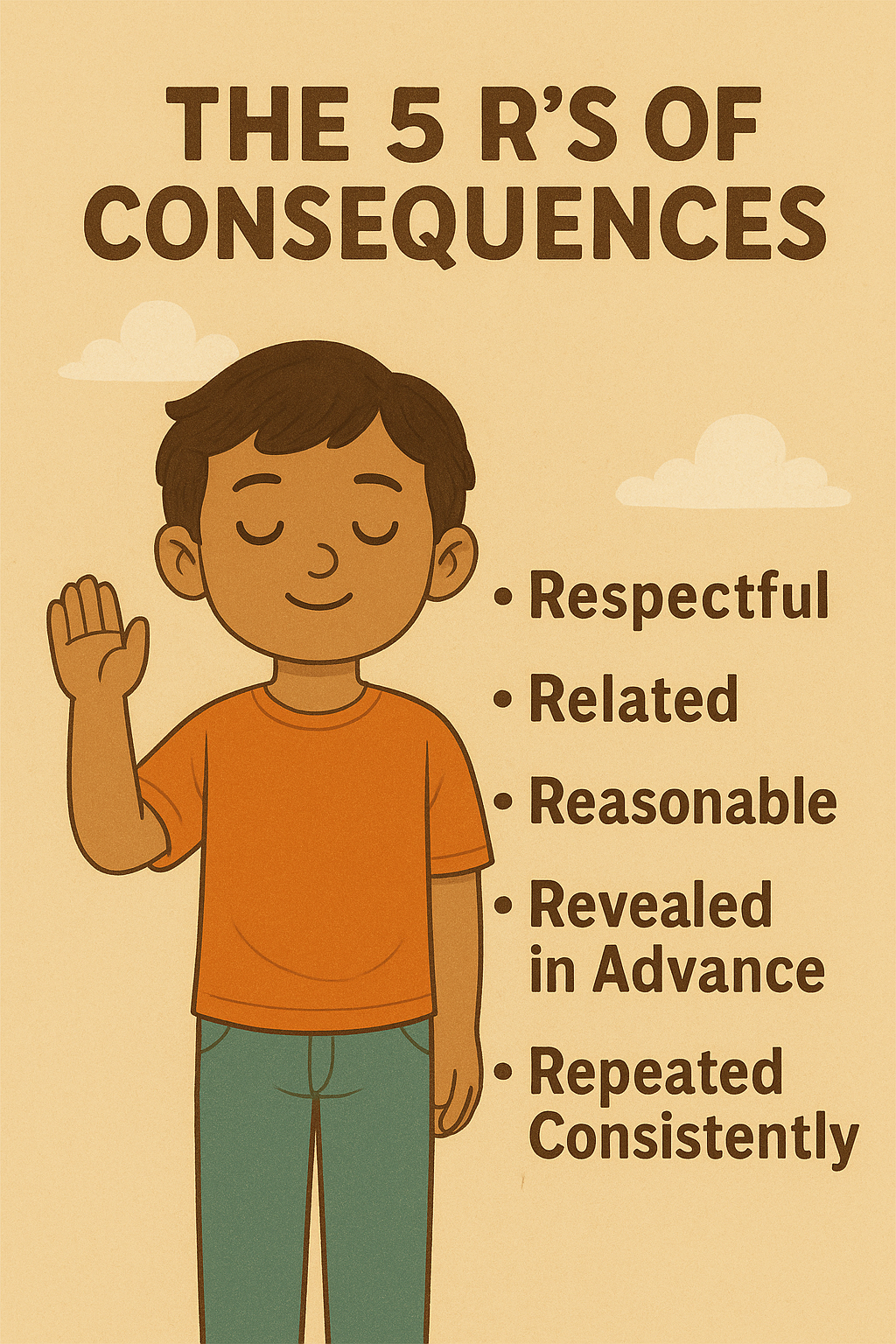
The 5 R’s are:
- Respectful
- Related
- Reasonable
- Revealed in Advance
- Repeated Consistently
Used mindfully, they turn discipline into guidance instead of fear — structure instead of shame.
🌼 1. Respectful: Discipline Should Never Humiliate a Child
Mindful parenting begins with the understanding that children deserve the same dignity we expect as adults.
A respectful consequence:
- Is delivered with calm tone and grounded presence.
- Avoids shaming, blaming, or overpowering.
- Shows the child they are loved even while being corrected.
For example:
Instead of “Go to your room right now!”
Try: “I can see you’re upset. We’ll take a break and talk when you’re calm.”
Respect reflects back emotional safety – the foundation of learning.
🌿 2. Related: The Consequence Must Match the Behaviour
A related consequence helps children understand natural cause and effect.
Examples:
- If a child throws a toy, the toy is put away for a while.
- If they spill something during play, they help clean it.
- If they shout hurtful words, they repair the connection with kindness.
When consequences directly connect to the behaviour, children build insight rather than resentment.
This is where mindfulness shines:
We pause, breathe, observe, and respond intentionally – not reactively.
🌙 3. Reasonable: The Consequence Must Fit the Situation
Mindful discipline honours the child’s developmental stage, emotional state, and capacity.
A reasonable consequence:
- Doesn’t escalate the situation.
- Isn’t harsher than needed.
- Gives the child a chance to succeed next time.
Instead of:
“You’ve lost screen time for a week!”
Try:
“Let’s take 20 minutes away from screens to reset and try again later.”
Reasonable consequences preserve connection, not fear.
🌞 4. Revealed in Advance: Children Need Predictability to Feel Safe
A child will always push a boundary they don’t fully understand. When expectations and consequences are explained clearly before a conflict arises, children feel:
- Safer
- More cooperative
- More responsible
- Less reactive
For example:
“Markers stay at the table. If they get used on walls, we’ll switch them for crayons.”
Clarity creates calm – for everyone.
🔁 5. Repeated Consistently: Consistency Builds Trust
The most mindful, respectful consequence means very little if it only happens occasionally.
Consistency teaches children:
- “I can trust the boundary.”
- “I know what happens when I choose this behaviour.”
- “My parent is calm and predictable.”
Consistency is a form of love – a structure children relax into because it feels safe.
Mindfulness supports this by helping adults stay steady, regulated, and grounded, even on hard days.
Helping children reflect daily builds resilience, and our mindfulness-based feelings journal was created specifically to support that journey.
🌈 Where Mindfulness Meets the 5 R’s
Mindfulness is the “glue” that holds this whole framework together.
It allows you to:
- Pause before speaking.
- Breathe before reacting.
- See beneath the behaviour.
- Respond from clarity instead of anger.
- Teach through connection, not control.
When discipline comes from a mindful place, children don’t just learn rules – they learn self-awareness.
✏️ Using Journaling to Help Children Understand Consequences
This is where your Mindful Explorer journals become powerful tools.
After a consequence, children can reflect through guided prompts like:
- “What happened before the consequence?”
- “What feeling did you have in your body?”
- “What would you like to try next time?”
- “What helps you feel calm when you’re upset?”
Reflection builds responsibility.
Awareness builds resilience.
Mindfulness builds connection.
This is how we raise emotionally intelligent kids.
If you want to nurture emotional confidence at home, you can explore our Feelings Journal here.
🌟 Final Thoughts: Discipline Without Fear Is Possible
The 5 R’s give structure.
Mindfulness gives compassion.
Together, they create discipline that protects connection instead of damaging it.
Children learn best when they feel safe, seen, and respected.
Mindful discipline isn’t about letting things slide – it’s about teaching with presence rather than pressure.
And when children feel grounded enough to reflect on their feelings, your mindfulness journals become a bridge toward emotional growth.